


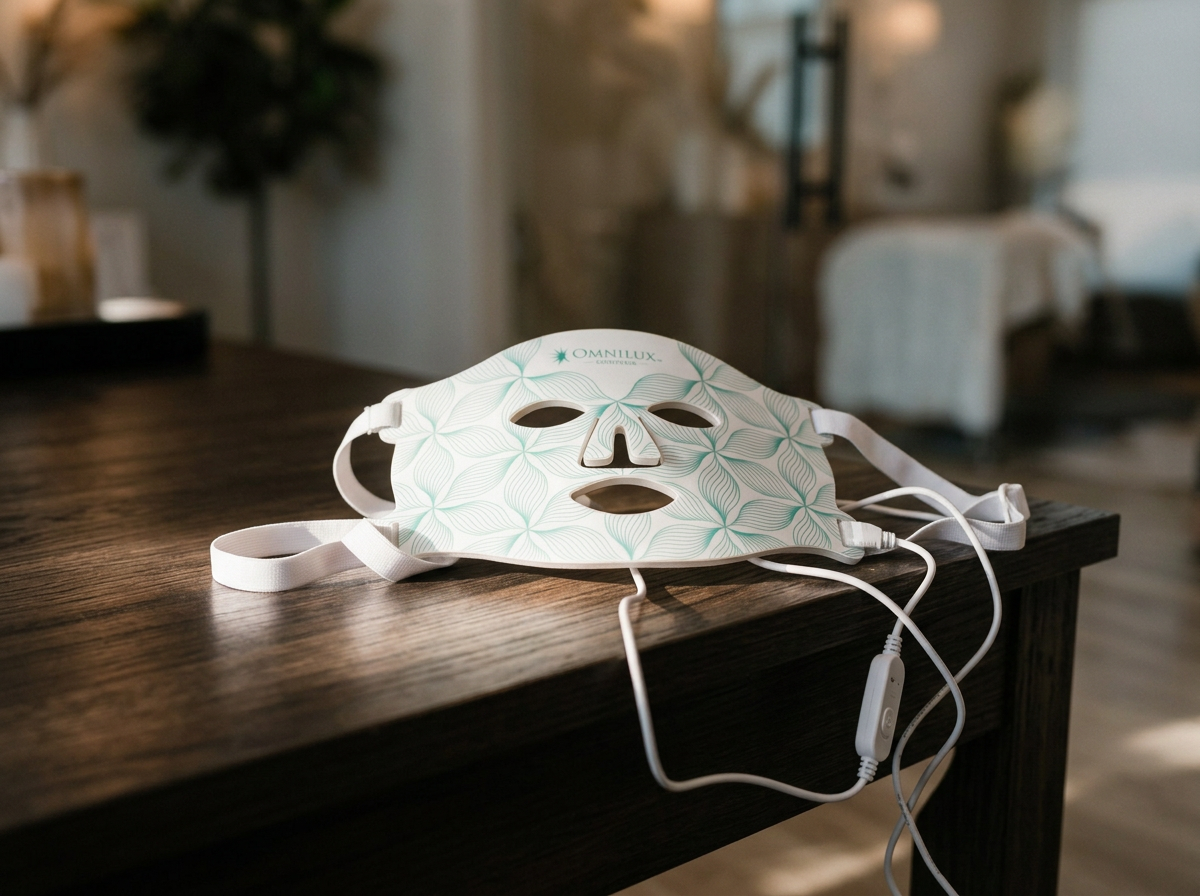
Omnilux LED Therapy: The Science-Backed At-Home Mask That Actually Works
One of my favorite moments in the treatment room is the end of a facial, when a client looks in the mirror and says, “Okay, why can’t my skin look like this every day?”
And my honest answer is: a lot of it can, if we keep supporting your skin between visits.
That’s really what at-home LED light therapy is. It’s not a replacement for your products, and it’s not a replacement for professional treatments. It’s the layer in between, a little piece of the treatment room that comes home with you, keeps working on your couch, and helps you hold onto (and build on) the results we create together.
That’s why I brought Omnilux into Freckled Skin Studio. As a licensed esthetician, I’m selective about technology, and this is the at-home LED line with the receipts to back it up. Let me walk you through how it works, what the research shows, and how it fits into a real routine, whether you’re focused on fine lines, breakouts, or simply keeping that post-facial glow going longer.

Think of Your Skincare in Layers
Here’s how I explain it in the studio. Healthy, consistent results usually come from three layers working together:
- Your daily products: cleanser, moisturizer, SPF, and targeted actives that protect and support your skin every single day
- Professional treatments: the in-studio work, where we can go deeper and create meaningful change
- Consistent at-home support: the layer that maintains, refines, and builds on everything else between visits
LED light therapy lives in that third layer. It doesn’t compete with your serums or your facials. It supports the same goal they do ✨healthy, functioning skin✨ from a different angle, on the days you’re not in my treatment room.
And because it asks so little of you (ten minutes, sitting still, no downtime), it’s one of the easiest layers to actually stay consistent with. Which matters, because consistency is where results live.
What Is LED Light Therapy and How Does It Work?
LED light therapy, also called photobiomodulation, uses specific wavelengths of light that reach different depths of the skin. The science traces back to NASA research — a fun fact to share while you’re sitting there in a glowing mask and your family has questions.
Here’s the why behind it: when certain wavelengths of light are absorbed by your skin cells, they’re taken up by the mitochondria — the little energy engines inside each cell. Omnilux explains that this stimulation is designed to support cellular energy production, which in turn supports the skin’s natural processes, like:
- Natural collagen and elastin activity
- Cellular repair and renewal
- A calmer, less reactive appearance
- Overall tone, texture, and radiance
Different wavelengths do different jobs. Per Omnilux, red light (633nm) is associated with natural cellular repair and renewal for a more radiant-looking complexion, while near-infrared light (830nm) reaches deeper fibroblast cells to support new collagen and elastin production. Blue light (415nm) works at the surface, where it’s designed to target the bacteria associated with breakouts.
In other words: your products care for the surface daily, your professional treatments create change, and light therapy supports the cellular processes underneath that help all of it along.
“LED therapy isn’t about replacing your routine. It’s about giving your skin a few quiet minutes of support between everything else you’re already doing.”
Why I Chose Omnilux for Freckled Skin Studio
I’m selective about what earns shelf space here, and Omnilux is the at-home LED line I confidently recommend. The why is simple: receipts.
Omnilux reports that its light therapy technology is backed by more than 40 peer-reviewed clinical studies and is used in over 5,000 dermatology and aesthetic offices worldwide. The at-home devices are FDA-cleared — Contour Face for fine lines and wrinkles, and Clear for mild-to-moderate acne — which means they went through a formal FDA review process, not just a marketing department.
It’s also the same category of medical-grade technology used professionally, in a flexible at-home design. Omnilux describes the Contour as a convenient way to maintain in-clinic treatment results — which is exactly the role it plays for my clients. The contoured fit matters more than people realize, too: light therapy depends on the light actually sitting close to your skin. A rigid mask hovering an inch off your cheekbones is mostly just mood lighting.
Does Red Light Therapy Work for Fine Lines and Wrinkles?
This is where Omnilux stands out, because instead of vague promises, the brand publishes its clinical study results.
In Omnilux’s clinical study of the Contour Face, 25 participants between ages 30 and 65 used the device three times per week, 10 minutes per session, for four weeks. One week after the final treatment, Omnilux reports the study found:
- A 38.7% improvement in skin smoothness
- A 37.6% reduction in wrinkle number and width
- A 29.3% improvement in elasticity
- A 19.4% improvement in hydration
The self-reported results were just as encouraging: Omnilux states that 93% of participants agreed their skin felt softer, smoother, and brighter after just one treatment, and 72% strongly agreed their fine lines appeared less visible by the end of the study.
Those are the brand’s reported findings from a small study, and individual results vary, your skin, your consistency, and your overall health all play a role. But it’s exactly the kind of documented evidence I want behind anything I recommend.
1. Omnilux Contour Face: The red (633nm) and near-infrared (830nm) device, and the one I reach for with clients focused on firmness, texture, and the appearance of fine lines — and with anyone who wants to support their professional treatment results between visits. Omnilux recommends 10-minute sessions 3–5 times per week for 4–6 weeks — genuinely doable while you watch TV, which is when most of my clients (and I) actually do it.
Omnilux


Does Blue Light Therapy Help with Breakouts?
For breakout-prone skin, Omnilux Clear combines blue light (415nm), designed to target acne-associated bacteria at the skin’s surface, with red light (633nm) to support the skin’s natural recovery process.
This device has published research behind it, too. Omnilux Clear’s clinical study was published in the Journal of Clinical and Aesthetic Dermatology in 2025, and the brand reports that after four sessions per week for six weeks, 93% of participants saw a decrease in inflammatory acne. Omnilux also describes Clear as the only flexible home-use LED mask with FDA, TGA, and CE clearance for treating acne.
What I love about this option for my breakout-prone clients: it layers gently into whatever else their skin needs. You don’t have to choose between light therapy and your cleanser, your professional plan, or your spot treatments — it works alongside them, supporting a calmer-looking complexion while your skin does its natural recovery work.
One honest caveat: the FDA clearance is for mild-to-moderate acne. If you’re dealing with cystic or hormonal acne, a device is one supportive layer within a bigger plan — that deserves professional guidance and often a conversation with a dermatologist.
2. Omnilux Clear: The blue and red light device designed for skin prone to breakouts. Omnilux recommends four 10-minute sessions per week for six weeks, then using it at the first signs of a breakout.
Shop Omnilux Clear →
How LED Therapy Supports Your Professional Treatments
This is my favorite part, because it’s where the “bringing the treatment room home” idea really earns its keep.
Professional treatments like chemical peels, microneedling, and in-studio LED do the deeper work — and then your skin spends the days and weeks afterward recovering, rebuilding, and revealing those results. That recovery window is where consistent at-home support shines. Omnilux notes that its Contour device can be used to maintain the results of in-clinic treatments, and red and near-infrared light are specifically designed to support the skin’s natural repair and renewal processes.
So instead of thinking of your facial as something that fades until your next appointment, think of LED therapy as the bridge between visits: a few quiet sessions a week that help your skin keep doing what we started in the studio.
Timing matters, though — especially right after a professional treatment or injectables. Bring your device to your next appointment conversation and we’ll map out spacing that makes sense for your specific plan. For Botox or fillers, always follow the guidance of the provider who performed them.
How Long Does LED Light Therapy Take to Show Results?
Here’s the honest answer: weeks, not days.
Omnilux’s Contour Face study measured results over four weeks of consistent use, and the brand recommends a 4–6 week initial series. For Clear, the study period was six weeks. Many people notice their skin looking brighter and feeling smoother early on — in the Contour study, most participants reported softer, brighter-feeling skin after a single session — but the measured changes came from consistent use over the full study period.
Individual results vary based on your skin, your health, what’s driving your concerns, and — the big one — your consistency. Using a device once a week and hoping is a little like going to the gym once and checking for abs. Consistency is the whole game.
One detail I respect: Omnilux recommends using the devices 3–5 times per week rather than daily, because the brand notes it hasn’t studied daily use. That’s the kind of honesty I wish more of the beauty industry practiced.
Is LED Light Therapy Safe? Who Should Avoid It?
LED light therapy is generally considered one of the gentler options in skincare because it doesn’t rely on exfoliation, heat damage, or strong actives. It’s noninvasive, and red and near-infrared light are designed to support a calmer-looking complexion — which is part of why it layers so easily alongside the rest of a routine, including for sensitive skin that can’t tolerate much else.
That said, it’s not for everyone. Light therapy isn’t recommended if you’re pregnant or nursing, have active or suspected skin cancer, take photosensitizing medications without medical clearance, or have a light-sensitivity disorder. If you have an autoimmune condition affecting your skin, talk with your healthcare provider first — and always review the contraindications in your device’s user guide.
Who Might Consider Adding LED Light Therapy to Their Routine?
This is one of those rare tools that fits a lot of different skin stories. You may want to explore Omnilux if you’re:
- Wanting to maintain and build on your professional treatment results between studio visits
- Focused on supporting firmness, texture, and the appearance of fine lines
- Dealing with recurring mild-to-moderate breakouts and want a gentle layer that works alongside your routine
- Sensitive or reactive and looking for support that doesn’t ask your skin to tolerate more actives
- Looking for something you can realistically stay consistent with at home — no appointment, no babysitter, no commute
If you take prescription medications, are pregnant or nursing, or have a medical condition affecting your skin, please talk with your healthcare provider or dermatologist before starting light therapy.
How I Pair LED Therapy with a Real Skin Analysis
Here’s what makes the studio approach different from buying a device off the internet and hoping: I don’t recommend anything before I’ve actually looked at your skin.
Every consultation at Freckled Skin Studio includes analysis with the Glimpse Professional Skin Evaluator, an LED skin analyzer that captures high-resolution images of surface texture, underlying pigmentation, inflammation patterns, and UV damage that hasn’t surfaced yet.
That analysis tells us how LED therapy fits into your bigger picture — which device suits your concerns, how it should layer with your products and professional treatments, and whether we need to address something else first, like a compromised barrier. Your skin gets to decide, not a trend.
Where to Buy Omnilux LED Devices
You can shop Omnilux devices through Freckled Skin Studio. And if you want the full picture first — which I always recommend — book a consultation so we can look at your skin together and build a routine where every layer, from your cleanser to your facials to your ten minutes of glow time, is working toward the same goal.
If you’re local to Rockwall, Texas, Rockwall County, or the surrounding Dallas area, come see us in the studio. If you’re elsewhere in the United States, you can shop our available professional devices and skincare online and have them shipped directly to you.
Ready to bring a little piece of the treatment room home?
Shop Omnilux LED Devices →
Request a Consultation →
LED Light Therapy FAQ
What is the difference between red light and blue light therapy? Per Omnilux, red light (633nm) is associated with cellular repair and renewal, near-infrared light (830nm) reaches deeper to support collagen and elastin production, and blue light (415nm) works at the surface to target acne-associated bacteria. Red and near-infrared are the anti-aging pairing; blue and red together are the breakout-focused pairing.
Is Omnilux FDA-cleared? Yes — Omnilux states its Contour Face device is FDA-cleared for fine lines and wrinkles, and its Clear device holds FDA, TGA, and CE clearance for treating mild-to-moderate acne.
How often should you use an Omnilux device? Omnilux recommends 10-minute sessions 3–5 times per week for Contour Face (for an initial 4–6 weeks), and four 10-minute sessions per week for six weeks for Clear. The brand recommends against daily use because it hasn’t been studied.
Can I use LED light therapy with my current skincare routine? Yes — that’s the point. Use the device on clean, dry skin so the light reaches properly, then apply your products afterward. If you use prescription treatments like tretinoin or take photosensitizing medications, check with your provider first.
Can I use LED therapy after facials, peels, or microneedling? LED therapy is often used to support and maintain professional treatment results, and Omnilux describes its Contour device as a way to maintain in-clinic results at home. Timing after a treatment matters, though, so ask your esthetician or provider when to resume — and for injectables like Botox or fillers, follow the guidance of the provider who performed them.
Can I use LED therapy if I have sensitive skin? LED therapy is generally one of the gentler options because it doesn’t rely on exfoliation or strong actives. Every skin is different, though, which is why a consultation helps us find the right fit for your sensitivity patterns.
Does LED light therapy work for cystic acne? Omnilux Clear is FDA-cleared for mild-to-moderate acne. For cystic or hormonal acne, a device can be one supportive layer, but it’s not a standalone solution — talk with a dermatologist or book a consultation so we can build a complete plan.
A note about LED light therapy: This post is provided for educational purposes and shares Haley’s professional experience as a licensed esthetician. Individual results vary. Clinical statistics referenced in this post reflect the manufacturer’s reported study findings. At-home LED devices and skincare products are not intended to diagnose, treat, cure, or prevent any disease or medical condition beyond their cleared indications. If you have a medical skin concern, take medications, are pregnant or nursing, or have questions about whether light therapy is appropriate for you, please consult your healthcare provider or dermatologist.
Leave a comment